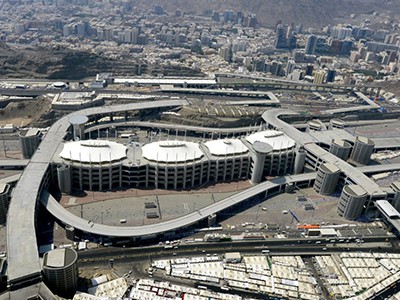
Each of the small stones that pilgrims throw in Mina during the days of Eid al-Adha, and the three separate places where these stones are thrown, are called a Jamrah; the plural is Jamarat. Starting from the Mina side, the Jamarat are, in order:
The First Jamrah (the small devil): The place where Satan appeared to Abraham (a.s.) for the third time and was stoned. On the first day of Eid, the first and second Jamrahs are not stoned.
The Second Jamrah (the middle devil): The place where Satan appeared to Abraham (a.s.) for the second time and was stoned.
The Third Jamrah (Jamrat al-Aqabah, "the great devil"): The place where Satan appeared to Abraham (a.s.) for the first time and was stoned. On the first day of Eid only the great Jamrah is stoned, after which one pauses briefly for supplication.
The distance between the first and the middle Jamrah is 156.40 m, and between the middle Jamrah and Jamrat al-Aqabah 116.77 m. The hadith books record that Abraham (a.s.), after completing the construction of the Kaaba, performed his first Hajj under the guidance of Gabriel (a.s.), and that when he was taking his son Ishmael (a.s.) to be sacrificed, he stoned Satan at these three places as Satan tried to prevent him from carrying out Allah's command.
The Prophet (s.a.w.) also threw stones at these Jamarat during the Farewell Pilgrimage, and specifically wished that the manner of performing the Hajj be learned from him on this occasion.
The Stoning of the Devil
Authentic hadiths clearly state that this practice is based on the Sunnah of Abraham (a.s.), and emphasise that it symbolically represents the stoning of Satan. Known as "the Stoning of the Devil," these throws keep alive the memory of Abraham's (a.s.) stoning of Satan, and represent a form of defiance and resistance against the devil, who constantly tries to lead people into sin. The location of the Jamarat in Mina was marked with stone markers from pre-Islamic times. However, until the 19th century there was no marker or enclosing wall limiting the area within which the stones were to fall. In early 1875, iron railings were built around Jamrat al-Aqabah in order to prevent the crowding that could result from getting too close to the Jamrah. However, out of concern that people might understand this as an enlargement of the area for throwing stones, these railings were removed a year later, and basin-shaped walls were built around all three Jamarat to mark the area where the stones should fall. In 1975 the site of the Jamarat was reorganised, to prevent crowding, as a two-level structure with a road 40-80 metres wide and 1 km long; and, as had happened before, after many pilgrims died in the crush during the 2006 Hajj, work was carried out to widen the stoning sites.
Share
Related articles
The Significance and Spiritual Value of Hajar al-Aswad
The history of the Black Stone, its role in tawaf, and the etiquette of istilam.
The Birthplace of the Prophet (s.a.w.)
The Prophet (s.a.w.), sent as a mercy to all the worlds, honoured the earth on 20 April 571 CE, on the night …
Arafat
Mount Arafat is our mountain, there our prayers are accepted (Yunus Emre) Arafat, a flat area on …