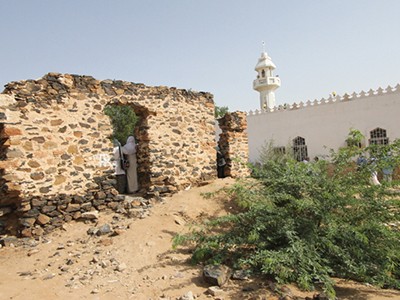
Outside the boundaries of the Haram, northwest of Mecca al-Mukarramah, 24 km from the Masjid al-Haram, lies the place now called Shumaysi. Here took place the Bay'at al-Ridwan and the Treaty of Hudaybiyyah (Sulh al-Hudaybiyyah). Six years had passed since the Hijrah. The Emigrants longed deeply for their homeland, for the families they had left behind in Mecca, and for a visit to the Kaaba. As described in verse 28 of Surah al-Fath, before setting out the Prophet (s.a.w.) had seen in a dream that he and his Companions entered Mecca al-Mukarramah in safety and performed an Umrah, and he had related this. In the 6th year of the Hijrah the Prophet (s.a.w.) came with about 1,400 Companions, intending to perform Umrah, as far as the well of Hudaybiyyah (Shumaysi). The Quraysh sent horsemen to prevent them from entering Mecca al-Mukarramah. The Prophet (s.a.w.) sent some Companions to Mecca al-Mukarramah to negotiate with the Quraysh and explain his purpose, but without success. He then sent Uthman (r.a.). Uthman (r.a.) told them that their only purpose was to visit the Kaaba and that they would then return to Medina al-Munawwarah. They replied that only Uthman would be allowed to visit the Kaaba, and that the others would not be permitted. When Uthman (r.a.) said he would never accept this without the Messenger of Allah (s.a.w.) and his companions, the idolaters disliked his stance and imprisoned him. News then reached the Messenger of Allah (s.a.w.) that Uthman (r.a.) had been martyred. As soon as he heard this, the Messenger of Allah called his Companions to swear allegiance to him and to march on Mecca to avenge what had been done to Uthman (r.a.). The Muslims swore beneath the Tree of Ridwan to fight the idolaters to the last. This pledge was named "Bay'at al-Ridwan."
لَقَدْ رَضِيَ اللّٰهُ عَنِ الْمُؤْمِن۪ينَ اِذْ يُبَايِعُونَكَ تَحْتَ الشَّجَرَةِ فَعَلِمَ مَا ف۪ي قُلُوبِهِمْ فَاَنْزَلَ السَّك۪ينَةَ عَلَيْهِمْ وَاَثَابَهُمْ فَتْحًا قَر۪يبًاۙ ﴿١٨﴾ وَمَغَانِمَ كَث۪يرَةً يَأْخُذُونَهَاۜ وَكَانَ اللّٰهُ عَز۪يزًا حَك۪يمًا﴿١٩﴾
"Indeed, Allah was pleased with the believers when they pledged allegiance to you under the tree (at Hudaybiyyah); He knew what was in their hearts, so He sent down tranquillity upon them and rewarded them with a near victory and much booty that they would take. And Allah is Ever Mighty, All-Wise." (Surah al-Fath, 18-19). When the idolaters heard of this, they resolved to make peace. Uthman (r.a.) returned safely. The Quraysh presented their wish for peace, and first the Treaty of Hudaybiyyah was signed, which appeared to be against the interests of the Muslims but was in reality a victory. Sacrificial animals were slaughtered and they returned without performing the Umrah. The Prophet's (s.a.w.) dream came true the following year, on 7 Dhul-Qa'dah AH (March 629 CE); the Umrah performed in compensation went down in history under the name "Umrat al-Qada." The place where the treaty was concluded probably lies east of the place called "Shumaysi," near a cemetery about 1 km away. According to those who have studied the subject, the place the Holy Qur'an calls "tahta al-shajarah" (beneath the tree) is right beside the trees at the edge of the cemetery mentioned. About 2.5 km east of Shumaysi there stands a monument marking the boundary of the Haram.
Share
Related articles
The Significance and Spiritual Value of Hajar al-Aswad
The history of the Black Stone, its role in tawaf, and the etiquette of istilam.
The Birthplace of the Prophet (s.a.w.)
The Prophet (s.a.w.), sent as a mercy to all the worlds, honoured the earth on 20 April 571 CE, on the night …
Arafat
Mount Arafat is our mountain, there our prayers are accepted (Yunus Emre) Arafat, a flat area on …