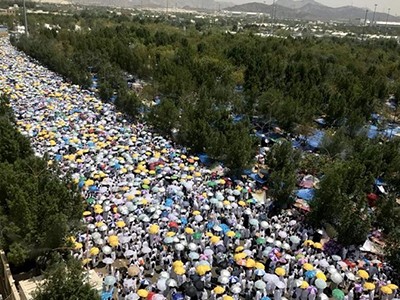
Muzdalifah lies between Arafat and Mina, within the boundaries of the Haram, and is the sacred place where the second Wuquf is performed after the Wuquf of Arafat. Muzdalifah, whose total area is 963 hectares and whose boundaries are today marked with signposts, lies 13 km from Mecca al-Mukarramah. During the Farewell Pilgrimage, after the Wuquf of Arafat, the Prophet (s.a.w.) came to Muzdalifah, settled near the hill of Quzah, and led the combined Maghrib and Isha prayers at the time of Isha. Muzdalifah means "nearness" and "gathering."
The name is given because, during the Hajj season, people descending from Arafat gather here and draw near to Allah through remembrance, supplication and Wuquf, and because this place brings them nearer to Allah. Muzdalifah is also the place where Adam (a.s.) and our mother Eve were reunited after Arafat. Because people gather together here and pray the Maghrib and Isha prayers together once the time of Isha has entered, it is also called Jam' ("gathering, coming together").
Some scholars have also held that, in the Holy Qur'an:
فَاِذَٓا اَفَضْتُمْ مِنْ عَرَفَاتٍ فَاذْكُرُوا اللّٰهَ عِنْدَ الْمَشْعَرِ الْحَرَامِۖ
"And when you depart from Arafat, remember Allah at al-Mash'ar al-Haram" (Surah al-Baqarah, verse 198) - they held that this verse's "al-Mash'ar al-Haram" refers to Muzdalifah. Others have argued that it refers to the hill of Quzah in Muzdalifah, where the Prophet (s.a.w.) performed the Wuquf. Beside the hill of Quzah in Muzdalifah stands a blessed mosque named Masjid al-Mash'ar al-Haram (Masjid Adam).
The Wuquf of Muzdalifah:
Performing the Wuquf in Muzdalifah is obligatory (wajib). During the Farewell Pilgrimage, after the Wuquf of Arafat, the Prophet (s.a.w.) came to Muzdalifah, settled near the hill of Quzah, and led the combined Maghrib and Isha prayers at the time of Isha. After resting until dawn, the Prophet (s.a.w.) rose early and led the dawn prayer. He then mounted his camel and came to the hill of Quzah, and, in accordance with Allah's command, "And when you depart from Arafat, remember Allah at al-Mash'ar al-Haram," he faced the Qibla, uttered the takbir and the tahlil, and prayed. He continued his Wuquf until it grew light. He set off for Mina before sunrise. Muzdalifah is the place where the Prophet (s.a.w.) was given the glad tidings that even those burdened with the rights of others (huquq al-'ibad) would be forgiven, and the place where the devils are left in despair.
The Prophet (s.a.w.) repeated here the supplication he had made in Arafat for the forgiveness of his Ummah, and smiled afterwards. When asked the reason, he explained that he smiled because he saw that his supplication had been accepted by Allah, and because he saw how despairing the devil became upon learning of it. According to the Hanafi and Shafi'i schools, it is Sunnah for pilgrims, after leaving Arafat at sunset, to spend the night that joins the Day of Arafah to the day of the feast in Muzdalifah until the time of the dawn prayer; according to the Malikis it is Mandub, and according to the Hanbalis, Mustahab. Remaining for a set period and performing the Wuquf, however, is wajib according to these schools.
The Time of the Wuquf of Muzdalifah: According to the Hanafis, who base themselves on the fact that the Prophet (s.a.w.) left Muzdalifah before sunrise, the time of the Wuquf begins with the break of true dawn (the entry of the time of the dawn prayer) on the day of Eid al-Adha and ends with sunrise. If one is present in Muzdalifah during this period for even a short while, the wajib obligation is fulfilled. According to the Hanafi school, a Wuquf performed before dawn or after sunrise is not valid.
Share
Related articles
The Significance and Spiritual Value of Hajar al-Aswad
The history of the Black Stone, its role in tawaf, and the etiquette of istilam.
The Birthplace of the Prophet (s.a.w.)
The Prophet (s.a.w.), sent as a mercy to all the worlds, honoured the earth on 20 April 571 CE, on the night …
Arafat
Mount Arafat is our mountain, there our prayers are accepted (Yunus Emre) Arafat, a flat area on …